





900+ clinicians shared our products on FrontrowMD, with no compensation.
Key Takeaways
- Eczema has a strong genetic component — identical twin studies show heritability of around 75%, but concordance is never 100%, meaning genetics alone don't determine outcome.
- The filaggrin gene mutation is the single strongest known genetic risk factor for eczema — present in up to 50% of people with moderate to severe atopic dermatitis.
- Having a genetic predisposition means a compromised barrier and heightened immune reactivity — but environmental and bacterial factors determine whether and how severely eczema actually develops.
- You can't change your genes. But you can support your skin barrier, manage your environment, and address the bacterial drivers that turn genetic vulnerability into active flares.
- Consistent daily barrier support is the most evidence-backed intervention for people with a genetic predisposition to eczema.
If eczema runs in your family, you've probably wondered how much of it was inevitable. The research is clear that genetics play a significant role — but they don't tell the whole story. And the part they don't tell is exactly where you have the most influence.
What the Twin Studies Tell Us
The clearest evidence for eczema's genetic component comes from twin research. Identical twins — who share nearly all their DNA — have a concordance rate for atopic dermatitis of 0.72 to 0.86. That means if one identical twin has eczema, there's a 72–86% chance the other does too.
For fraternal twins, who share around half their DNA, that rate drops to 0.15 to 0.23.
The difference is significant. It tells us that genetic factors account for a large portion of eczema susceptibility — researchers estimate heritability at around 75%. Eczema is one of the more heritable common skin conditions.
But here's what's equally important: even in identical twins who share virtually all their DNA, concordance is never 100%. That gap — the cases where one identical twin has eczema and the other doesn't — is where environment, microbiome, and lifestyle factors come in. Genes load the gun. Other factors pull the trigger.

The Filaggrin Gene: The Most Important Piece of the Puzzle
Of all the genetic variants associated with eczema, one stands out above the rest: mutations in the filaggrin gene.
Filaggrin is a protein that plays a central role in forming the skin barrier — binding skin cells together and maintaining the tight structure that keeps moisture in and irritants out. When the filaggrin gene carries a loss-of-function mutation, the barrier becomes structurally compromised from birth. Moisture escapes more easily. Bacteria and allergens penetrate more readily. The skin is, from the start, more reactive and more vulnerable.
Up to 50% of people with moderate to severe atopic dermatitis carry a filaggrin gene mutation. Filaggrin haploinsufficiency — where one copy of the gene is affected — is associated with approximately a threefold increased risk of eczema. It's also strongly linked to the "atopic triad" — eczema, asthma, and hay fever — appearing together.
This is why eczema reasons so often trace back to early childhood, why it clusters in families, and why it frequently appears alongside other atopic conditions. The genetic vulnerability was already there.

Genetics Isn't the Whole Picture
Here's where the science gets more hopeful.
Having a filaggrin mutation doesn't mean eczema is inevitable — or that its severity is fixed. Research consistently shows that genetic predisposition interacts with environmental exposures. The mutation creates vulnerability; the environment determines how that vulnerability expresses itself.
Neonatal exposure to cats, for example, increases eczema risk in infants who carry a filaggrin mutation — but not in those who don't. The genetic variant and the environmental exposure interact to produce the outcome. Neither alone is sufficient.
The same logic applies to humidity and temperature. Cold, dry air reduces filaggrin expression even in people without mutations — while higher humidity supports barrier function. Diet, stress, sleep, and the skin's microbial environment all influence how a genetic predisposition plays out in practice.
This is a meaningful distinction. It means that even if you've inherited a vulnerability, the factors that determine how that vulnerability manifests — how often you flare, how severely, and how quickly you recover — are significantly within your influence.
The Bacterial Layer Nobody Talks About
One factor that often gets overlooked in the genetics conversation is the skin microbiome.
In people with filaggrin mutations, the compromised barrier creates conditions that favour Staphylococcus aureus (Staph) colonisation — altered skin pH, reduced competing bacteria, and physical gaps in the barrier structure. Staph is present on up to 90% of eczema-affected skin during active flares, compared to around 5–20% on healthy skin.
Staph isn't just a consequence of having eczema. It actively sustains the flare cycle — producing toxins that further disrupt the barrier, driving inflammation, and directly activating itch nerve receptors. In people with a genetic predisposition, this bacterial layer is a major reason why eczema keeps coming back even when triggers are removed.
This is why addressing the bacterial environment matters as much as supporting the skin barrier — particularly for people who know their skin is genetically predisposed.

What You Can Actually Control
You can't change your genes. But the research is clear that genetics aren't destiny — and that consistent, daily management of the factors you can control makes a measurable difference.
Support the skin barrier daily. For people with filaggrin mutations, the barrier is structurally compromised between flares, not just during them. Daily barrier support — with occlusive and emollient ingredients that reduce transepidermal water loss — keeps the skin less permeable and less reactive. Waiting until things get bad means the bacterial and inflammatory cycle has already taken hold.
Manage the bacterial environment. A formula that addresses Staph alongside barrier repair targets the driver that turns genetic vulnerability into active flares. Without this, even well-maintained barrier support leaves the bacterial cycle running.
Reduce known environmental triggers. Harsh soaps, fragrance, hot water, dry air, and certain fabrics all worsen barrier function — particularly in genetically predisposed skin. These aren't the cause of eczema, but they're the switches that activate it.
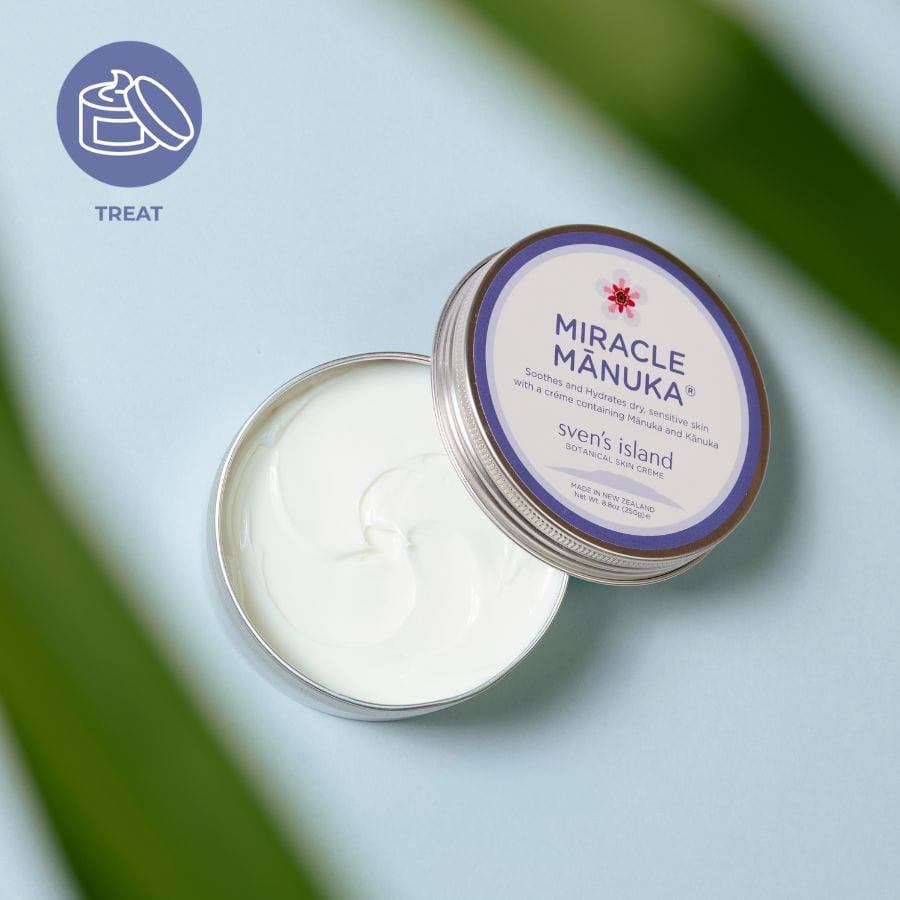
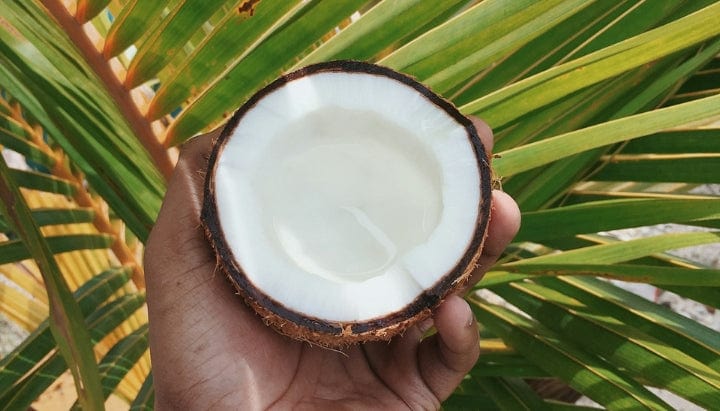
Sven's Island Miracle Manuka Creme is formulated with Manuka leaf oil and Kanuka, both clinically shown to fight Staph bacteria, alongside marshmallow root and coconut oil to support barrier repair — steroid-free, fragrance-free, and safe from birth.
Designed for consistent daily use between flares, it addresses both the barrier deficit and the bacterial environment that genetic vulnerability creates. 95% of users noticed significant improvement after 2 weeks, and it's trusted by 150,000+ families managing eczema-prone skin.

What the Research Shows
Twin studies consistently estimate eczema heritability at around 75%, with identical twin concordance rates of 0.72–0.86 compared to 0.15–0.23 in fraternal twins — confirming a strong genetic component while leaving a significant role for environmental factors.¹
Filaggrin loss-of-function mutations are the single strongest genetic risk factor identified for atopic dermatitis, present in up to 50% of moderate-to-severe cases and associated with approximately a threefold increased eczema risk in carriers.² These mutations directly increase transepidermal water loss and reduce barrier integrity — explaining the early-onset, chronic pattern characteristic of filaggrin-associated eczema.³
Research confirms that genetic predisposition and environmental exposure interact: the same filaggrin mutation carries different levels of risk depending on early-life exposures, reinforcing that genetic vulnerability is not deterministic.¹
Frequently Asked Questions
Is eczema inherited from parents?
Yes — eczema has a strong hereditary component, with heritability estimated at around 75%. Having one parent with atopic dermatitis significantly increases a child's risk. Having two parents with atopic conditions increases it further. But heritability isn't destiny — environmental and bacterial factors play a significant role in whether and how severely the condition develops.
If eczema is genetic, can it be prevented?
The genetic predisposition can't be prevented, but its expression can be influenced. Consistent daily barrier support — particularly in infancy — has been shown to reduce eczema severity in high-risk children. Managing environmental triggers, avoiding harsh soaps and fragrances, and addressing the bacterial environment reduce the factors that activate genetic vulnerability into active flares.
Why do some people with eczema in the family not develop it themselves?
Genetic predisposition is one factor in a multi-factor condition. Even identical twins with shared DNA don't always both develop eczema — confirming that environmental exposures, microbiome composition, and other factors determine whether the genetic vulnerability activates. Not carrying a filaggrin mutation also significantly reduces risk.
Does eczema get passed down through the mother or father?
Both. Eczema risk can be inherited from either parent. Research has shown that mothers with a filaggrin gene mutation increase their child's eczema risk even independently of whether the child inherits the mutation itself — suggesting maternal effects on early skin development. Risk is cumulative when both parents carry atopic conditions.
Can you develop eczema even without a family history?
Yes — while family history significantly increases risk, eczema can develop without it. Filaggrin mutations can arise spontaneously, and other genetic variants beyond filaggrin are also involved. Environmental factors — early-life microbiome disruption, antibiotic exposure, diet, and pollution — can contribute to eczema development in the absence of strong family history.
A Final Thought
You can't change your genes. But eczema is not a fixed sentence written into your DNA.
The research is clear: genetic predisposition creates vulnerability — a barrier that leaks more easily, an immune system that fires more readily. What you do with that vulnerability, consistently every day, is where the real difference is made.
Consistent daily barrier support and managing the bacterial environment can help reduce eczema severity and frequency, whether you are genetically predisposed to it or not.
More than 150,000 Australian families have made the switch. Try Sven’s Island Miracle Manuka Creme for 60 days — if your skin doesn’t improve, get your money back. No questions asked.
References
¹ Thomsen SF, Ulrik CS, Kyvik KO, et al. (2007). Importance of genetic factors in the etiology of atopic dermatitis: a twin study. Allergy and Asthma Proceedings, 28(5):535–539. https://pubmed.ncbi.nlm.nih.gov/17883909/
² Palmer CNA, Irvine AD, Terron-Kwiatkowski A, et al. (2006). Common loss-of-function variants of the epidermal barrier protein filaggrin are a major predisposing factor for atopic dermatitis. Nature Genetics, 38(4):441–446. https://pubmed.ncbi.nlm.nih.gov/16550169/
³ Flohr C, England K, Radulovic S, et al. (2010). Filaggrin loss-of-function mutations are associated with early-onset eczema, eczema severity and transepidermal water loss at 3 months of age. British Journal of Dermatology, 163(6):1333–1336. https://pubmed.ncbi.nlm.nih.gov/20716217/
Don’t Miss These
Works well with SELF-CARE


- $15.00 NZD
-
$25.00 - $15.00 NZD
- -40%
- Unit price
- per


- $79.20 NZD
-
$145.00 - $79.20 NZD
- -32%
- Unit price
- per
- $79.20 NZD
-
$115.00 - $79.20 NZD
- -14%
- Unit price
- per


- $55.20 NZD
-
$135.00 - $55.20 NZD
- -49%
- Unit price
- per


