




900+ clinicians shared our products on FrontrowMD, with no compensation.
Key Takeaways
- Your skin hosts trillions of microorganisms — bacteria, fungi, and other microbes — that together form your skin microbiome.
- In healthy skin, this microbial community is diverse and balanced, with beneficial bacteria actively keeping harmful species in check.
- In eczema-prone skin, that balance breaks down: microbial diversity drops, and Staphylococcus aureus dominates — a shift strongly linked to flare severity.
- Research by Kong et al. (2012) found a direct correlation between worsening disease severity and lower skin bacterial diversity during flares.
- The goal isn't to sterilise the skin — it's to support conditions where beneficial bacteria can thrive alongside a healthy barrier.
- Ingredients clinically shown to fight Staph bacteria, like Manuka leaf oil and Kanuka, address the bacterial side of this equation without disrupting the broader microbiome.
Most people think of bacteria as something to get rid of. But your skin is home to trillions of microorganisms — and the ones doing the most damage in eczema aren't there because your skin is dirty. They're there because the balance has shifted.
Understanding that distinction changes everything about how you approach eczema management.
What Is the Skin Microbiome?
Your skin microbiome is the community of microorganisms — bacteria, fungi, viruses, and other microbes — that live on and within your skin. In healthy skin, this community is remarkably diverse. Hundreds of species coexist in an established balance, each playing a role in maintaining the skin's environment.
This isn't just passive cohabitation. Beneficial bacteria actively work to protect the skin. They produce antimicrobial compounds, crowd out harmful species, and communicate directly with the immune system — helping it distinguish between genuine threats and harmless environmental exposures.
Think of it less like a sterile surface and more like a living ecosystem. When the ecosystem is diverse and balanced, it's resilient. When it's disrupted, the whole system becomes vulnerable.
What Happens to the Microbiome During a Flare
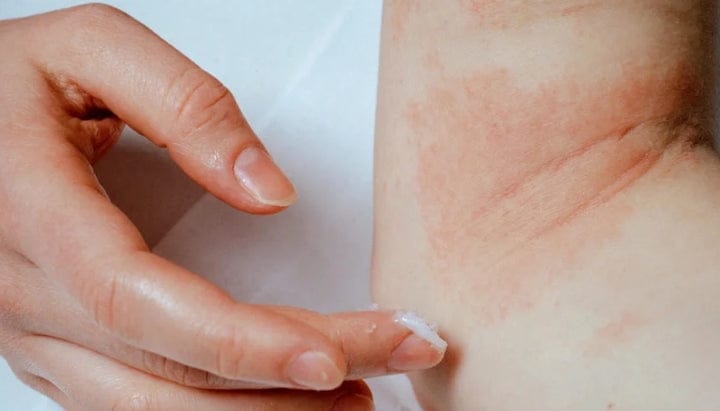
In eczema-prone skin, the microbiome looks fundamentally different from healthy skin — and nowhere is that more clear than during a flare.
In healthy skin, Staphylococcus aureus (Staph) makes up a small fraction of the microbial community, kept in check by beneficial commensal bacteria. During an eczema flare, that balance collapses. Staph dominates — sometimes exceeding 40% of the total bacterial community at affected sites — while microbial diversity drops sharply.
This isn't just a side effect of eczema. It's a driver of it.
The clearest evidence for this came from a landmark 2012 study by dermatologist Heidi Kong and colleagues at the National Institutes of Health. They tracked the skin microbiome of children with atopic dermatitis across three states — baseline, active flare, and post-treatment — and found a strong inverse relationship between disease severity and microbial diversity. The sicker the skin, the less diverse its bacterial community.
Crucially, diversity recovered as the skin improved. It didn't just correlate with skin health — it tracked it in real time, suggesting that restoring microbial balance is as relevant to eczema management as treating inflammation or repairing the barrier. The three are deeply connected.
Why Beneficial Bacteria Matter
The beneficial bacteria that live on healthy skin — particularly species like Staphylococcus epidermidis — don't just passively occupy space. They actively compete with Staph by producing antimicrobial compounds, and they help regulate the skin's immune response.
When Staph crowds out these beneficial species, the skin loses that protective activity. The barrier becomes more vulnerable to Staph's toxins. Inflammation worsens. And the conditions that allowed Staph to dominate in the first place get reinforced — creating a self-sustaining cycle that's hard to break.
This is why understanding the bacterial cycle in eczema often comes back to the same insight: a flare can keep feeding itself even after the original trigger is gone. The bacterial imbalance becomes the mechanism that sustains the flare.
The Problem With "Kill All Bacteria" Thinking
This is where the nuance matters. If the goal were simply to eliminate bacteria from the skin's surface, you'd be doing as much harm as good — wiping out beneficial species along with the harmful ones.
Harsh antibacterial approaches, including some topical antibiotics used long-term, can reduce microbial diversity in ways that actually make the skin more susceptible to future Staph colonisation. You remove the competing species and Staph has less opposition when it returns.
The more useful framing is this: the goal is to create conditions on the skin where beneficial bacteria can thrive, Staph is kept in check, and the barrier can do its job. That's a meaningfully different approach from simple sterilisation — and it's where ingredients like Manuka leaf oil and Kanuka are particularly relevant.
Both have demonstrated antibacterial activity against Staph specifically, without the broad-spectrum disruption that comes with harsher approaches. Supporting the skin's barrier alongside this bacterial balance gives beneficial species the environment they need to re-establish themselves.
The Barrier-Bacteria Connection
The skin barrier and the microbiome don't operate independently — they're deeply interconnected.
A damaged skin barrier changes the microenvironment on the skin's surface: pH shifts, moisture levels drop, and the conditions that normally support microbial diversity deteriorate. Staph, which binds more easily to damaged skin, takes advantage. As it colonises, its toxins further damage the barrier — which worsens the conditions for beneficial bacteria, which allows Staph to spread further.
This is why repairing the skin barrier isn't a separate concern from managing the bacterial side of eczema. They're the same problem approached from two angles. Does bacteria cause eczema — or does eczema create conditions where bacteria cause more damage? The honest answer is that the relationship runs in both directions, and addressing only one side rarely breaks the cycle for long.

What This Means in Practice
For people managing eczema day to day, the microbiome research points toward a few practical principles.
Consistent barrier support matters — not just during flares, but between them. A well-maintained barrier creates a more stable environment for commensal bacteria and gives Staph less of a foothold.
Fragrance-free, minimal-ingredient formulas reduce the risk of disrupting the microbiome with unnecessary chemical exposure. Many fragrance compounds have antimicrobial properties — which sounds positive, but can reduce microbial diversity indiscriminately.
Ingredients with targeted activity against Staph — rather than broad-spectrum antibacterials — are more aligned with the goal of supporting rather than disrupting the skin's microbial community.
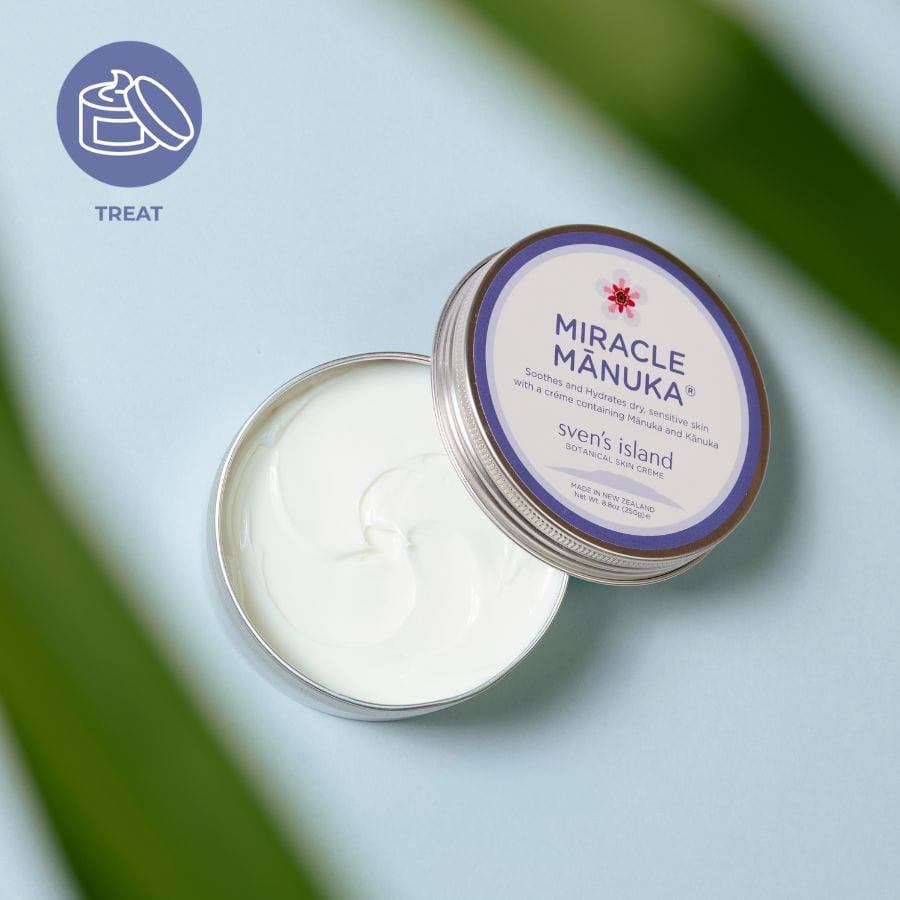
Sven's Island Miracle Manuka Creme is formulated with Manuka leaf oil and Kanuka, both clinically shown to fight Staph bacteria, alongside marshmallow root to support barrier repair. Steroid-free, fragrance-free, and safe from birth. 95% of users noticed significant improvement after 2 weeks, and it's trusted by 100,000+ families managing eczema-prone skin.
What the Research Shows
Kong et al. (2012) established the foundational link between microbial diversity and atopic dermatitis severity, showing diversity dropped during flares and recovered with treatment.¹
Subsequent research has confirmed and extended these findings. A decrease in microbiome diversity correlates with disease severity, with reductions in commensal genera including Streptococcus, Corynebacterium, and Cutibacterium as Staph increases.² Staphylococcus epidermidis, a key commensal species on healthy skin, has been shown to produce antimicrobial compounds that actively inhibit Staph — suggesting a direct protective function that is lost when diversity drops.³
Research into microbiome-based therapeutic approaches — including the topical application of antimicrobial commensal bacteria — has demonstrated reductions in Staph colonisation and improvements in eczema severity scores, supporting the view that restoring microbial balance is a viable therapeutic target.²
Frequently Asked Questions
What is the skin microbiome?
The skin microbiome is the community of microorganisms — including bacteria, fungi, and other microbes — that live on the skin's surface and within its outer layers. In healthy skin, this community is diverse and balanced, with beneficial species actively protecting against harmful bacteria, regulating immune responses, and supporting barrier function.
Does bacteria cause eczema?
Bacteria doesn't cause eczema directly — atopic dermatitis involves genetic, immune, and barrier factors that precede bacterial involvement. But the bacterial imbalance that characterises eczema-prone skin, particularly the dominance of Staph, plays a significant role in sustaining flares and worsening severity. Addressing the bacterial side of eczema is an important part of managing the flare cycle.
What is Staphylococcus aureus and why does it matter for eczema?
Staph is a type of bacteria that is present on the skin of most people in small amounts without causing problems. In eczema-prone skin, Staph colonises at much higher levels — particularly on damaged skin where it can bind more easily. It produces toxins that disrupt the skin barrier, trigger inflammation, and worsen the itch-scratch cycle, making it a key driver of flare severity and persistence.
Can you improve the skin microbiome?
Research suggests that supporting a healthy skin barrier, using gentle fragrance-free products, and addressing Staph colonisation with targeted rather than broad-spectrum approaches can help restore conditions where a more diverse, balanced microbiome can re-establish itself. Microbiome diversity has been shown to recover as skin health improves — the relationship appears to work in both directions.
Is killing bacteria on the skin a good idea for eczema?
Indiscriminate antibacterial approaches — particularly those that reduce overall microbial diversity — can be counterproductive for eczema-prone skin. The goal is to address Staph specifically, not to sterilise the skin, which would also eliminate the beneficial bacteria that help keep Staph in check. Targeted ingredients with demonstrated activity against Staph, used alongside consistent barrier support, are more aligned with what the microbiome research suggests.
A Final Thought
The skin microbiome isn't a fringe concept or an emerging trend. It's at the centre of how researchers now understand what drives eczema flares — and why so many people feel stuck in the same cycle no matter how many creams they try.
If the products you've been using only address moisture and inflammation, they're working on part of the picture. The bacterial balance is the part most standard creams don't touch.
More than 100,000 Australian families have made the switch. Try Sven's Island Miracle Manuka Creme for 60 days — if your skin doesn't improve, get your money back. No questions asked.
References
¹ Kong HH, Oh J, Deming C, et al. (2012). Temporal shifts in the skin microbiome associated with disease flares and treatment in children with atopic dermatitis. Genome Research, 22(5):850–859. https://pubmed.ncbi.nlm.nih.gov/22310478/
² Bjerre RD, Bandier J, Skov L, Engstrand L, Johansen JD. (2017). The role of the skin microbiome in atopic dermatitis: a systematic review. British Journal of Dermatology, 177(5):1272–1278. Cited in: https://pmc.ncbi.nlm.nih.gov/articles/PMC9189751/
³ Nakatsuji T, Chen TH, Narala S, et al. (2017). Antimicrobials from human skin commensal bacteria protect against Staphylococcus aureus and are deficient in atopic dermatitis. Science Translational Medicine, 9(378):eaah4680. https://pubmed.ncbi.nlm.nih.gov/28228596/
Don’t Miss These
Works well with SELF-CARE


- $15.00 NZD
-
$25.00 - $15.00 NZD
- -40%
- Unit price
- per


- $79.20 NZD
-
$145.00 - $79.20 NZD
- -32%
- Unit price
- per
- $79.20 NZD
-
$115.00 - $79.20 NZD
- -14%
- Unit price
- per


- $55.20 NZD
-
$135.00 - $55.20 NZD
- -49%
- Unit price
- per


